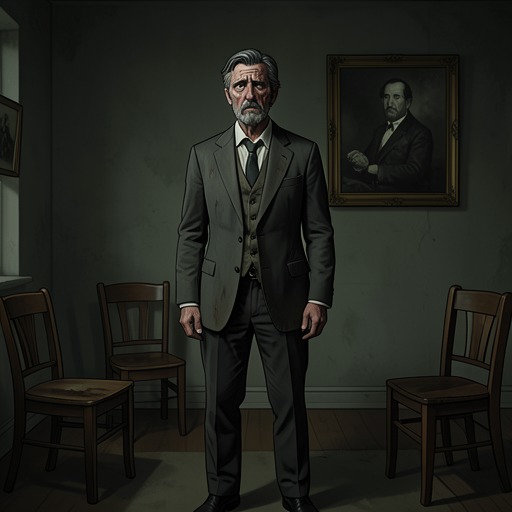
Mary Ruthven
Young Captain Jack · The Son of a SoldierMary Ruthven is the mother of St. John Ruthven and a member of the neighboring plantation family whose declining fortunes place her at the edge of social and economic insecurity. She is not merely a background relative: through her dependence on St. John, her contempt for Jack Ruthven’s adopted status, and her participation in a marriage scheme, she helps convert the novel’s questions about family into questions of property, rank, and moral worth.
Identity and Circumstances
Mary Ruthven lives with St. John on a plantation about half a mile from the bay. The plantation and some money in the bank were left to her son by his father, but both mother and son spend freely, and the property gradually deteriorates because St. John takes little interest in managing it. Their remaining funds fall below a thousand dollars, leaving Mary conscious that their manner of living cannot continue indefinitely. Her anxiety is practical and immediate: she urges St. John to attend to the plantation and its labor force, while he responds that the estate is not worth working and that he has no money with which to buy another place.
Mary’s position is shaped by indulgence as well as fear. The narrative describes her as doting on her only offspring, even while his wastefulness has helped bring the family toward ruin. This affection does not erase her social assumptions. She accepts the idea that the prosperity of Alice Ruthven’s household offers a possible escape from their own decline, and she views the enslaved people on the plantation in the dehumanizing economic language used by St. John. Her concern for survival therefore remains bound to the plantation order and to the status her family is trying to preserve.
The Marriage Scheme and Hostility to Jack
St. John proposes marrying Marion Ruthven so that the two plantations can be joined and both households can obtain a secure living. Mary has already considered the same plan, making her an active participant in the strategy rather than a passive observer of her son’s ambitions. She warns him not to delay, because Alice Ruthven and Marion may discover how financially desperate the family has become and reject him for that reason.
Her attitude toward Jack reveals the class prejudice beneath the scheme. When St. John complains that Marion is constantly with Jack, Mary scorns the boy as a “nobody” and resents the affection Marion shows him. She considers it foolish that Alice Ruthven has allowed Jack to think of himself as a Ruthven and treats his adoption as proof that he is not Marion’s equal. St. John has already told Jack that he does not belong to the Ruthven family and will someday have to leave; Mary does not object to this cruelty. Instead, she approves the social boundary it creates, because Jack’s exclusion makes the proposed marriage alliance appear more advantageous.
The contrast with Alice Ruthven’s household is central to Mary’s characterization. Alice’s home is prosperous, and Alice treats Jack as a son; Mary sees that emotional bond as an obstacle to her own family’s advancement. Her view of kinship is consequently divided between biological descent, social rank, and financial usefulness. The novel later confirms that Jack is legally and emotionally part of the Ruthven family through adoption, while Mary’s attempt to deny that belonging exposes the limits of her own definition of family.
War, Fear, and the Plantation Crisis
When a letter calls St. John to join the army, Mary witnesses the collapse of the identity he has tried to maintain as a privileged young planter. He claims that he is too sick to serve, and the narrative records Mary’s disgust at finding her only offspring a coward, although she herself does not want him to leave her. Her response contains a divided feeling: maternal attachment makes her wish to keep him safe, but her recognition of duty makes his evasion shameful.
That contradiction becomes more severe when Federal troops approach the plantation. St. John rises in terror, and Mary tells him that the Yankees are coming and that he must arm himself to defend their home. His chattering fear makes clear that he is unable to fulfill the role expected of him. The household’s danger therefore exposes a moral deficit that financial planning had concealed: the man who hoped to acquire another plantation through marriage cannot even stand confidently before the threat to his own.
Jack, by contrast, goes toward the danger. After hearing the firing, he organizes a small group and runs to the plantation. Mary meets him on the veranda in distress, declaring that the house is doomed. Jack answers by directing her to gather pails and buckets and asking whether a ladder is available. Later, when the effort to save the house requires cutting into the roof, Mary comes out carrying a bundle in one hand and a jewelry box in the other, demanding an explanation. The image captures both sides of her character: she is frightened and concerned with preserving valuables, yet she remains physically present in the crisis while Jack undertakes the practical defense.
Jack’s Identity and the Reconstitution of Family
Mary’s connection to Jack is also indirectly transformed by the revelations about his origin. The early rumor that Jack is not truly part of the Ruthven family causes him anguish, but Alice Ruthven explains that her late husband and she adopted him when he was three or four. The law therefore recognizes him as her brother, and Alice insists that he is her son in every meaningful emotional sense. Mary’s contempt for him stands against this stronger model of family, in which adoption creates both obligation and love.
The mystery initially produces competing claims. Dr. Mackey announces that he is Jack’s father, but that claim is later disproved when Jack is identified as the son of Colonel Stanton. The evidence surrounding the shipwreck includes the unmarked clothing of Jack’s dead mother, an unmarked lace handkerchief, and a ring whose worn inscription could not be read even by two jewelers. These objects preserve the mystery without resolving it, while the adoption by Alice and her husband gives Jack a stable family before his biological identity is known.
When Colonel Stanton’s claim is proved, Jack’s position changes materially as well as emotionally. He becomes the colonel’s son and inherits a fortune recovered after Dr. Mackey is prosecuted and imprisoned. Yet the resolution does not erase his bond with Alice. Colonel Stanton initially considers returning North, but Alice cannot bear to part with Jack, so the families decide to remain at the plantation. A year later, Colonel Stanton marries Alice, making her once again Jack’s mother by marriage as well as by the long-standing relationship created through adoption.
Ending and Narrative Significance
Mary’s final appearance is marked by absence as much as presence. She attends the double wedding at the plantation, where Colonel Stanton marries Alice and Marion Ruthven marries Dr. Harry Powell, but St. John is conspicuously absent. The son around whom Mary’s hopes, anxieties, and calculations had centered is excluded from the celebration because his conduct has separated him from the moral community the ending assembles.
Her trajectory thus runs parallel to the novel’s larger movement from unstable possession toward chosen and legally recognized belonging. She begins by treating marriage as a financial remedy, defending family status through contempt for an adopted child, and depending on a son whose cowardice undermines the position he inherits. The conclusion places her outside the restored household’s emotional center, while Jack’s family is enlarged rather than diminished by the reconciliation of adoption, biological parenthood, and marriage. Mary Ruthven remains important precisely because her fears and prejudices reveal what the novel rejects: a household organized solely by property, rank, and blood cannot withstand crisis as securely as a family sustained by loyalty and care.